The number of people afflicted with Guinea worm worldwide continues to decrease, and public health officials believe that in the next few years the disease could be eradicated.
This year, there are projected to be fewer than 500 cases of Guinea worm, a parasite that invades the bodies of people in sub-Saharan Africa. Eradication is near, officials say, and credit belongs to health workers and volunteers.
“(Success) will demonstrate the power of two things: A grassroots approach and the power and importance of health education,” said Donald Hopkins, MD, MPH, vice president for health programs at the Carter Center, a nonprofit that is assisting national Guinea worm eradication programs.
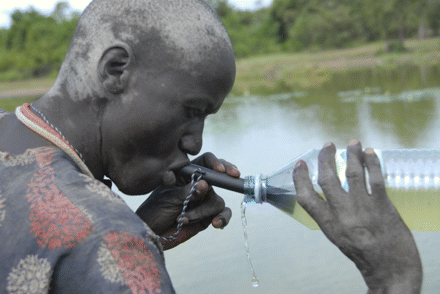
A man uses a pipe filter while drinking. Filtration can prevent Guinea worm infection.
Photo courtesy E. Staub, the Carter Center
There is no vaccine for Guinea worm disease. There is no treatment, and there is no way to diagnose a person with the worm until months after she or he has been exposed. Eradication is being achieved through education and convincing people to change habits that go back generations.
In 1986, about 3.5 million people in 21 countries in Africa and Asia had Guinea worm. Today that figure has been reduced by more than 99 percent. In the first six months of 2012, just 391 cases have been reported — a reduction of 52 percent over the same time last year. There has been one case each in Chad and Mali, two cases in Ethiopia and 387 cases in South Sudan. It will be the second human disease in history, after smallpox, to be eradicated.
When the disease is finally eradicated, it will prove that public health has the ability to eliminate a disease without the use of a vaccine, Hopkins told The Nation’s Health.
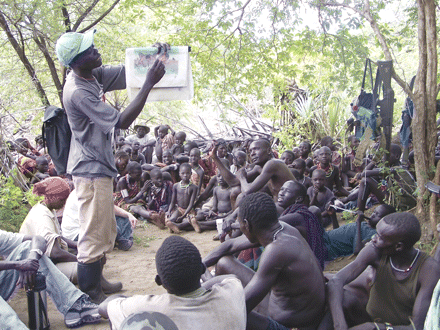
In 2008, a volunteer uses a flip chart to educate villagers in southern Sudan about Guinea worm disease prevention.
Photo by J. Albertson, courtesy the Carter Center
Guinea worm, or Dracunculus medenisis, enters a person’s body when the person drinks water that is contaminated with a water flea that hosts the larvae. The larvae, which are not killed by digestion, move through the person’s intestinal wall and grow and mate in the intestinal cavity.
When the fertilized female worm, which can be three feet long, is mature, it moves through the body, usually to the lower limbs, and exits the skin via a painful blister. The person, in pain from the blister, often dips her or his foot or leg in a nearby water source seeking relief, which allows the worm to release more larvae, and the cycle continues.
The whole process can take a year or more, and in decades past, 60 percent of some African villages were affected.
“It’s a terrible problem,” Hopkins said.
He said Guinea worm can devastate because it attacks poor people and the three main building blocks of society: health, agriculture and education. The worm most often strikes in rural areas where people depend on being able to farm. But people afflicted with an emerging worm are incapacitated and cannot do agricultural activities. Children often stay home from school, and many have been expelled because they could not keep up with their classes, he said.
Gautam Biswas, MD, leader of the World Health Organization’s Guinea worm eradication team, said eradication will dramatically improve lives.
“At the human level, it would mean individuals living in the former endemic areas no longer have to live with the fear of the disease resulting in temporary and sometimes permanent disabilities,” he told The Nation’s Health.
The road to eradication has not been easy, but it has rapidly accelerated.
The key to prevention is twofold, Hopkins said: People need to filter their drinking water or drink water from safe, underwater wells, and they need to stay away from water sources if they have an emerging worm.
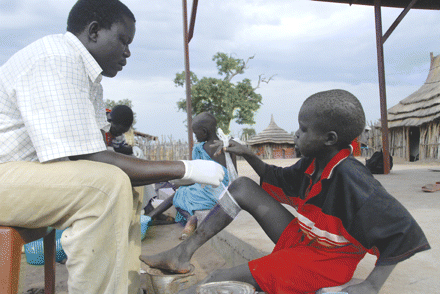
Nurse John Lotiki tends to 6-year-old Thom Mayon’s infected Guinea worm wound in Abuyong, South Sudan, in 2010.
Photo by E. Staub, courtesy the Carter Center
One barrier to preventing Guinea worm transmission is that prevention requires behavior change, said Jeffrey Bingenheimer, PhD, MPH, an assistant professor in the George Washington University School of Public Health and Health Services who focuses on health education and health promotion.
“Water filtration requires people to do something — filter their water — very consistently,” he told The Nation’s Health. “In general, we behavioral science types have a hard time getting people to do something consistently…for an extensive period of time.”
Though convincing people to take consistent steps that will eventually lead to better health is difficult, in recent years Guinea worm eradication has been successful in part because of the people behind the effort, Hopkins said.
“They are basically village volunteers,” he said.
There are technical assistants who train the volunteers, but the bulk of the work in the prevention and containment falls to people who often work within their own communities and those nearby.
According to the Centers for Disease Control and Prevention, village volunteers are the backbone of the Guinea worm eradication program. They track the number of cases and report to supervisors, who compile the data and share it with WHO, the Carter Center and CDC.
The grassroots approach works, Hopkins said, because people are more likely to trust those they know rather than outsiders.
“In these places there is a very, very strong influence of tradition,” Hopkins said. “People are suspicious of outsiders and have their own rationalities. For people to be persuaded, the most effective way is to have people they trust talk to them about the problem.”
Another key to successful eradication is case containment centers, where people with the worms can go for treatment and to avoid potentially contaminating local water supplies. In a study published in 2008 in the American Journal of Tropical Medicine and Hygiene, researchers found that in areas served by the centers, incidence of Guinea worm dropped by 71 percent in Togo and 42 percent in Ghana.
Biswas said the recent success can also be attributed to high-level prioritization of the issue by the ministries of health in endemic countries and the support of partners such as WHO, UNICEF and the Carter Center.
Today, South Sudan is the country with the highest rate of Guinea worm, and even there numbers are declining steadily. The country’s high rate of infection is related to a decades-long civil war that has raged there, Biswas said, noting that the country was only able to launch a full-scale eradication program in 2006.
For more information, visit www.cartercenter.org.
- Copyright The Nation’s Health, American Public Health Association