In 1982, the Centers for Disease Control and Prevention reported an “unexpected cluster” of previously healthy gay men who had been diagnosed with a rare form of cancer and a type of pneumonia that typically develops in people with weakened immune systems.
Today, the underlying cause of what would become a global epidemic is known as AIDS. But in the early days of the outbreak, it was referred to as Gay-Related Immune Deficiency.
“The original name only furthered misinformation because people assumed that it was only a gay disease,” said Anthony Hayes, managing director of public affairs and policy at Gay Men’s Health Crisis, which opened its doors in 1982 in response to the epidemic. “It allowed many people to pathologize gay men and assume all gay men had HIV. It created an enormous amount of stigma.”
More than three decades after the first documented disease clusters in California and New York City, Hayes said stigma around HIV/AIDS is still driving its spread and preventing people from getting tested. And while many factors created and contribute to the stigma, Hayes said the virus’ original name certainly played a role.
“Part of treating a disease is making sure we don’t create stigma,” he told The Nation’s Health. “How HIV and AIDS was originally treated and named was not a proper response. Today, we should look back on it as a lesson on how not to respond.”
The early days of AIDS are a poignant example of how a disease name can contribute to unintended social consequences; however, AIDS is hardly alone. From avian flu to Legionnaires’ disease to Middle East respiratory syndrome coronavirus, diseases named after people, places and animals can contribute to significant, and often negative, social and economic impacts, such as the unnecessary killing of agricultural animals and the stigmatization of entire regions.
“When you’re naming conditions or phenomena, you have to think about multiple key audiences,” APHA member Matthew Kreuter, PhD, MPH, founding director and senior scientist at the Health Communication Research Laboratory at Washington University in St. Louis, told The Nation’s Health. “This is a fascinating issue, because on one hand, you want the public to pay attention; but on the other hand, you don’t want it to be an exercise in fear and popularity.”
For example, during the 2009 H1N1 influenza pandemic, the virus was commonly referred to as swine flu, as it was similar to a strain found in pigs. However, H1N1 is primarily a human disease, transmitted from person to person and not from eating pork products. But despite assurances from global health officials that pork was not the cause of the 2009 pandemic, the name swine flu contributed to unnecessary culls of pigs and a sharp downturn in pork markets.
“These kinds of names can have an almost unbelievable economic impact on producers,” said Joni Scheftel, DVM, MPH, state public health veterinarian at the Minnesota Department of Health. “We’re talking about families and their livelihoods, so, yes, this really does matter.”
To avoid such scenarios and their unintended consequences, the World Health Organization released a set of best practices for naming new human diseases in May. The best practices, which apply to new infections, syndromes and diseases that have never been recognized or reported in humans, call on scientists and health officials to avoid naming diseases after geographic locations, animals, people and populations. Instead, the guidance encourages names that are descriptive of a disease’s effects and easy to understand. For example, severe acute respiratory syndrome, or SARS, is a good example of a disease name that aligns with the new naming guidelines, said Elizabeth Mumford, DVM, MS, a scientist at WHO.
“In this day and age, there are a lot of people in a position of having the first crack at naming a disease,” said Mumford, who coordinated development of WHO’s best practices for naming new human diseases. “Oftentimes, it’s a person in the media or a government official who uses a (misleading) name and it gets immediately adopted and spread through social media. And once it gets into common usage, it’s very, very hard to change.”
Mumford noted that the new naming practices are also in alignment with the International Classification of Diseases, which is managed by WHO and charged with assigning the human disease names used by health care providers worldwide to classify diseases and standardize disease documentation.
“(Disease names) can give a false sense of security to people outside of a certain region, as in the case of Middle East respiratory syndrome, and can have negative impacts on travel, trade and tourism,” Mumford told The Nation’s Health.
Historically, diseases were named after the people who discovered them, but that practice has gone out of fashion, said Daniel Bausch, MD, MPH&TM, a senior consultant for WHO and associate professor in the Department of Tropical Medicine at Tulane University. Plus, a disease named after its discoverer rarely offers the public helpful insights into how it affects the body, Bausch said. Naming diseases after geographic locations can also be misleading. For example, the name Rocky Mountain spotted fever may lead people to believe that the tick-borne disease is only a risk to those living in that region. But Bausch noted that most cases of the disease occur in states far from the Rocky Mountains.
Naming diseases requires a balancing act common in the field of health communications, said APHA member Jay Bernhardt, PhD, MPH, founding director of the Center for Health Communication in the Moody College of Communication at the University of Texas-Austin. In a disease outbreak, Bernhardt said health communicators must be “singularly concerned” with making sure the information is accurate, but equally as concerned with presenting information on which people can act — “having clarity and accessibility in naming is so important,” he said. Bernhardt recommended that including health and risk communication experts in the disease naming process could go a long way in preventing unintended negative consequences.
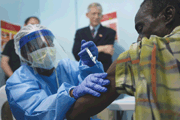
A nurse administers an injection in February in Monrovia, Liberia, as part of an Ebola vaccine study. Health officials are taking a closer look at the naming of diseases — such as Ebola, which was named after a river in Africa. New WHO guidelines advise against naming diseases after geographic locations, animals, people and populations, in part because of stigma.
Photo by John Moore, courtesy Getty Images
“People’s ability to understand the illness and react appropriately is arguably just as important or more important than scientists speaking with one voice,” he said.
In Old Lyme, Connecticut, John Sieviec, MSRS, chief sanitarian at the Old Lyme Health Department, has been diagnosed more than once with the tick-borne disease that was named after his community after a rash of cases were identified in the 1970s. Sieviec said there is a lingering stigma that visitors to Old Lyme will get sick with Lyme disease. But he noted it can be tricky to educate people about Lyme disease prevention without perpetuating misperceptions about his community.
“It’s a difficult balance,” he said. “But it’s something that’s always with us.”
To learn more about the new WHO guidelines, visit www.who.int.
- Copyright The Nation’s Health, American Public Health Association