Adriana Ochoa, language services supervisor at Arkansas Children’s Hospital in Springdale, talks with a family. Medical interpreters play a vital role for people who do not speak English, but their services are not reimbursed by many insurers.
Photo courtesy Arkansas Children’s Hospital
Adriana Ochoa remembers the stress of interpreting for her Spanish-speaking parents at doctor’s visits when she was young, worried she had missed a key word or misunderstood another.
“It’s a lot of responsibility for a child,” said Ochoa, the language services supervisor at Arkansas Children’s Hospital in Springdale, a small city in the state’s northwest corner. “And it’s not the best way to communicate with patients.”
A certified medical interpreter, Ochoa spends most of her time on the hospital floor, helping Spanish-speaking patients with limited English proficiency communicate with providers and navigate the facility’s systems. The hospital has an on-site staff of interpreters in Spanish and Marshallese — Springdale has one of the largest Marshallese communities in the U.S. — available around the clock, starting when a patient checks in.
Requests for language assistance come in all day, every day, Ochoa said. She carries a walkie-talkie with her so she can dispatch an interpreter seconds after getting a call, their skills crucial in emergencies.
“We make sure conversations are clearly interpreted,” she told The Nation’s Health. “But we also act as a bridge for cultural understanding.”
Language barriers are common across sectors, but their consequences can be especially severe in health care. More than 25 million U.S. people — nearly two-thirds of them Spanish speakers — have limited English proficiency, and research shows they often experience poorer health than their English-proficient peers, such as worse cancer outcomes, higher hospital readmission and more medical errors. They are also more likely to be uninsured and lack access to care.
Many health providers offer language assistance, but a considerable number of others do not, even when patients have a legal right to it. Federal civil rights law requires hospitals and other health providers that take federal funds, such as Medicare and Medicaid payments, to provide “meaningful access” to patients with limited English proficiency.
Data on compliance is limited, but show significant room for improvement. For example, a 2013 Medscape survey of more than 4,700 health providers in the U.S. found that less than one-third asked about language at intake, less than a quarter contracted with interpreter services, and almost 40% relied on patients’ families to interpret, which language-access experts caution against.
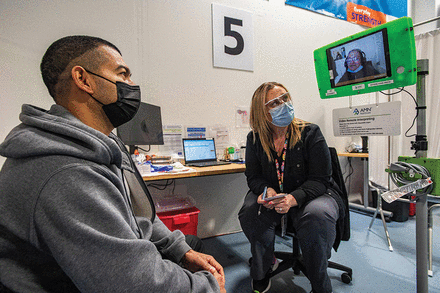
From left, patient Otto Delcid and nurse Nicole Colon work with a remote interpreter to go over medical questions at a UMass Memorial Health Care vaccination site in Worcester, Massachusetts, in 2021.
Photo by Joseph Prezioso, courtesy AFP/Getty Images
A 2014 study found only 64% of hospitals offered any language services.
Federal guidelines on the issue — the National Standards for Culturally and Linguistically Appropriate Services in Health Care, or CLAS standards — were released in 2000. But a 2010 study found few hospitals, just 13%, were following all of the language-related standards.
Lisa Diamond, MD, MPH, co-author of the 2010 study, said she suspects little progress has been made since, considering the standards are an unfunded mandate.
“In an ideal world, it would be policy to reimburse (language services) like we do for other medical procedures,” said Diamond, an associate attending physician at Memorial Sloan Kettering Cancer Center.

From left, Siu Williams, a certified medical interpreter, interprets for patient Son Van Vo and nurse practitioner Mary Nejedly at Stanford Medical Center in California in 2014.
Photo by Lea Suzuki, courtesy The San Francisco Chronicle/Getty Images
Not all insurers — including Medicare and most state Medicaid programs — reimburse for interpreter services, despite research showing interpreters improve health outcomes and are more effective than relying on ad hoc interpreters, such as family and friends. For example, a 2015 study that included Spanish-speaking patients at a public hospital clinic found that using trained medical interpreters cut the medical error rate in half, far below the error rate associated with ad hoc interpreters.
Mara Youdelman, JD, managing attorney for the D.C. offices of the National Health Law Program, said providers can comply with language-access laws in a number of ways, such as hiring in-person interpreters, contracting with video or telephone interpreting services, or training bilingual staff to interpret.
But the reality is that many health providers do not fully understand their legal obligations, she said. They may also lack funding to effectively comply or underappreciate the expertise that trained interpreters bring.
Better enforcement of the Civil Rights Act and more funding for language services would help narrow health inequities among people with limited English, Youdelman said.
“The skills of interpreting are vastly under-recognized,” she said. “They should be seen as an equal member of a patient’s health care team.”
There are between 20,000 and 40,000 health care interpreters working in the U.S., though it is unclear how many are properly qualified, said Natalya Mytareva, executive director of the Certification Commission for Healthcare Interpreters. Labor statistics do not differentiate medical interpreters from other interpreters, so it is hard to estimate the field’s ranks.
Since 2010, Mytareva reported, the commission has certified about 9,400 interpreters.
In addition to knowing how to interpret complicated medical terminology, Mytareva said qualified interpreters understand how communication works — “they can see when a misunderstanding is happening.” Professional interpreters are also free of conflicts of interests and emotional ties that can make family and friends ineffective at the job.
“Our job is to let the conversation happen as if both sides speak the same language,” she told The Nation’s Health.
Mytareva said demand for medical interpreters has been rising. Restricted visitation policies during the height of the COVID-19 pandemic left patients without family to help them communicate, showing the importance of such services. But low reimbursement makes it hard for many interpreters to earn a full-time living, she said.
Another strategy to improve language access is to train doctors to provide language-concordant care, an option many medical schools offer. A 2021 study of 125 U.S. medical schools found 78% offered medical Spanish programming, up from 66% a few years earlier.
Study co-author Pilar Ortega, MD, MGM, co-founder of the National Association of Medical Spanish, said more students may be learning medical Spanish, but their skills still need to be assessed in the exam room. For example, clinicians need to know when to acknowledge their language limitations and call in an interpreter.
“We know that clinicians who are multilingual use their skills — or want to — with patients because there are known benefits to that cultural concordance,” said Ortega, also vice president for diversity, equity and inclusion at the Accreditation Council for Graduate Medical Education. “But there’s not a standardized way to confirm their proficiency.”
Ortega echoed other advocates who said systems are often set up to disincentivize language-appropriate care, such as pressures to keep patient visits short, despite the extra time needed to work with an interpreter.
“Systems need to consider the realities of what is needed to provide equitable care,” Ortega said. “We need to reframe the concept of language as a tool we can use to improve people’s health, rather than a barrier to it.”
New work in Chicago highlights the long way many health systems have to go in providing equitable care to patients with limited English.
Last year, the local Asian Health Coalition launched its Health Equity Through Access to Language Strategy, or HEALS program. The first phase was an assessment that surveyed more than 400 residents and two health systems that serve Asian communities, said Alia Southworth, MPH, senior program director for health promotion at the coalition.
Among its findings: 42% did not know they had a right to an interpreter, 60% used a professional medical interpreter in the prior year, and 26% used family or friends as interpreters. Problems began even before some sat down with a clinician: Sixty-two percent of patients said they had trouble making an appointment, as language services may not kick in until the actual visit.
On the medical side, Southworth said providers lamented the high financial burden. For example, one clinic was spending $50,000 a month on language services — all of it unbillable.
“We’re dealing with a big disconnect here,” Southworth said. “Yes, it’s great that there are laws in place, but where’s the support to make it happen?”
For more information, visit www.healthlaw.org or www.kff.org/racial-equity-and-health-policy.
This article was updated post publication.
- Copyright The Nation’s Health, American Public Health Association